

Services
Our team’s experience allows us to cover all areas of Pathological Anatomy and support doctors, hospitals, medical centres and health insurance companies in precisely diagnosing diseases and personalised treatments.
Plus, we work to provide a highly personalised approach.

Head and neck

Skin
Endocrine
Gastrointestinal, hepatic and biliopancreatic

Gynaecological
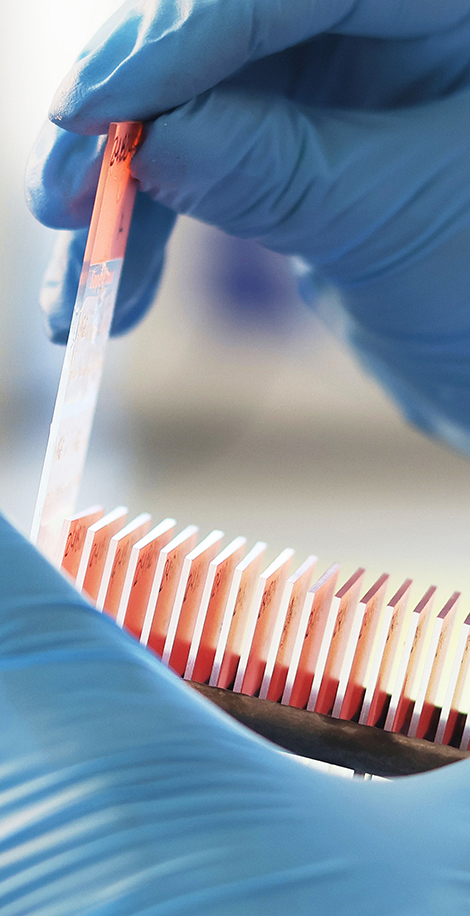

Breast

Soft tissues and bone

Neurological
Respiratory
Urological
What we do?
Fast, rigorous, quality pathological anatomy diagnoses of biopsies, surgical biopsies and cytology samples with a close, open relationship with the doctor treating the patients.
We enable diagnosis based on the excellent expertise of our professionals through technical processing that guarantees histology images, histochemical and/or immunohistochemical staining and molecular studies that allow for and ensure accurate, personalised diagnoses.
How do we do it?
When we receive a sample, with a request form, we then:
- Check the data on the request form matches the sample. Ensure rigorous quality control throughout.
- Log the sample into our computer system with the specific code for our laboratory, showing whether it is a histological or cytology sample.
- Check whether we have previous reports for the patient in our system.
Diagnostic biopsies and surgical biopsies: macroscopic description of the sample with the sizes, photo of the sample and selection of slices to put into paraffin.
Cytology: macroscopic description of the samples with their volume and characteristics.
Biopsy or surgical biopsy:
- Microscopic observation of the sample by the pathologist, macroscopic description and diagnosis.
- SNOMED topography and morphology codes for the case and number of cell blocks, preparations and special histochemical and immunohistochemical stainings carried out.
Cytological sample:
- Screening cytological preparations by cytotechnologists. Noting their diagnosis.
- Revision by the pathologist and, if necessary, joint revision with the cytotechnologists.
- Microscopic description and diagnosis.
- Proper SNOMED codes for the case and number of preparations and cell blocks (if applicable) and special histochemical and immunohistochemical staining.
The clients receive the reports online through the patient’s medical history. They can also see them using the “Check reports” link on this website or, if necessary, sending them in an encrypted email to the requesting physician.
How are samples submitted?
- Fill in the request form.
- Label the container with the patient’s name.
- Use a clean container with a wide mouth, filled to one-third volume with formaldehyde.
- Keep at room temperature.
- Fill in the request form.
- Label the container with the patient’s name.
- Use a large container with at least 10 times more formaldehyde than the sample by volume.
- Keep at room temperature.
- Fill in the request form.
- Write the patient’s name in pencil on the frosted strip on the slide.
- Smear onto the slide and set immediately with cytospray fixative.
- Fill in the request form.
- Smear twice on the frosted slides, labelled with the patient’s name in pencil.
- Set one immediately with cytospray fixative and label as such.
- Let the other smear air dry. Do not refrigerate.
- Put the rest of the material into a container with physiological serum (cleaning needle) or one-third volume cytology fixative.
- Refrigerate until sending to the lab.
- Fill in the request form.
- Take a sterile sample.
- Put the fluid into a clean container labelled with the patient’s name and add one-third volume of cytology fixative.
- Refrigerate until sending to the lab.
- Collecting the sample: before taking the sample, genitals must be cleaned with antiseptic soap and dried with sterile gauze. Discard the first urine in the morning and take the sample from the second. For serial urine testing, collect urine samples three days in a row.
- Fill in the request form.
- Put the fluid into a clean container labelled with the patient’s name and add one-third volume of cytology fixative.
- Refrigerate until sending to the lab.

© Patologia Integrada, 2024